Examples of torture used against climate activists – Our report for the UN committee against torture
02.12.2025
This is an incomplete collection of physical and psychological violence that could be labelled as torture as experienced by climate activists in the past 3 years.
👉 Physical torture
Transportation techniques / Pain grips / wrist locks
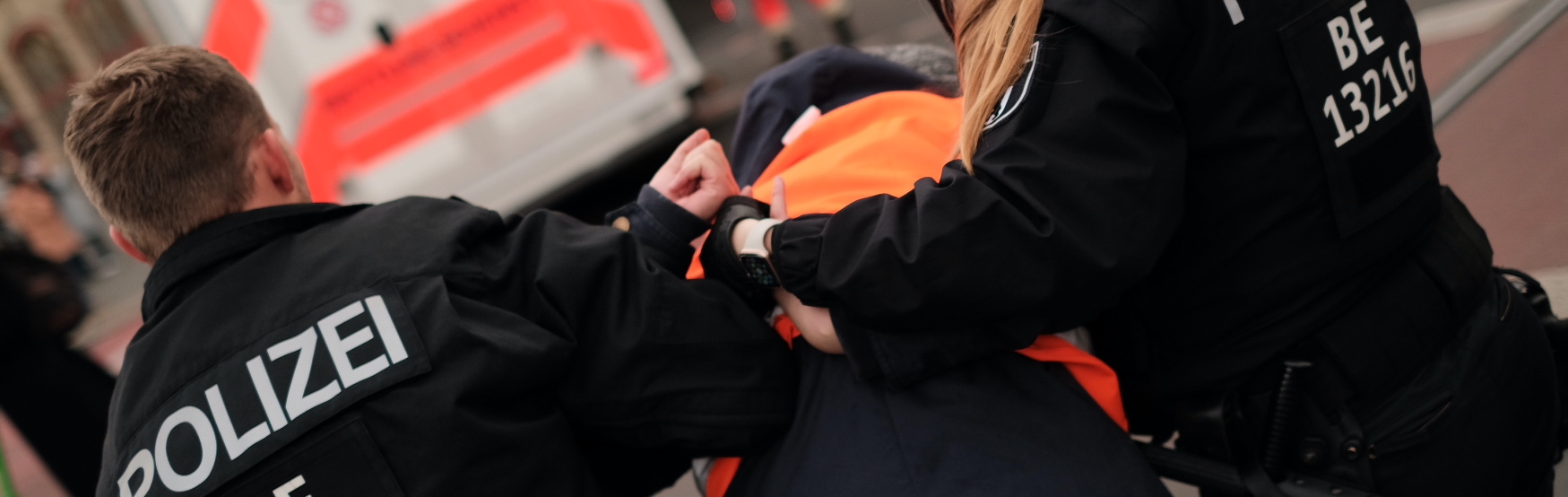
So-called transportation techniques are often used by the police to make activists leave the place of protest. Officially these should be used in such a way, that it is nearly impossible for the activist not to walk once lifted up. Instead of carrying the activist (which would be an alternative, since climate protesters will be trained to not defend themselves or resist being removed) two officers will hold the activist between them, bending the wrist sharply, which causes a lot of pain, but should not cause lasting damage. The reality looks very different. Police will:
- Inflict pain on people while they are still sitting and demanding the person get up themselves
- verbally threaten to or actually increase the pain over several minutes with no attempt to lift or remove the person
- Lifting the person and bending the wrists at an angle that makes it impossible for the person to get up
- Inflicting so much pain, that the person is unable to respond / react in a way that would get them out of the pain grip / walk by themselves
- Continuing the pain grip well after the person has started walking themselves
- Causing long lasting pain: people have reported pain for several days, weeks or even months
- Causing damage: people have had injuries that required surgery
- Verbally abusing, intimidating or threatening the person that the pain is inflicted on
Victim report – climate protest at gas lobby event
“My right wrist was now also painfully twisted. The police officers dragged me along the path, applying increasing pressure to my wrists. I repeatedly cried out, saying they were hurting me terribly. My eyes were closed in pain. I walked on my own. The officer on the left (BE 32005) only loosened his grip slightly, causing me further pain, while the officer on the right repeatedly increased the pressure, causing me further pain.”
Over the period 2022-2024 (until the Last Generation was disbanded) excessive use of pain grips became increasingly common. Whilst at the start of protests these were used occasionally with a wide variation on how “ambitious” individual police were in applying the pain grips, by 2023 pain grips where often used on all individuals in all protests within a protest phase with very high intensity throughout, suggesting that police were very likely to have been instructed to use the method with a clear aim to hurt and intimidate and as a result discourage people from taking part in future protests.
Additional physical torture meassures
In Berlin, where the majority of protests took place, certain units are especially “happy” to inflict pain (and will say so to protesters). These units were more and more often assigned to those protests that were publicly announced. By 2024, in addition to “transportation techniques” applied to the wrists, pain was also increasingly inflicted by:
- Grabbing the face, pulling up the nose in a painful way
- Using pain points on the jaw, pulling people from the ground by their head/neck
- Ripping peoples glued on hands off the street surface or other people’s hands
- Kneeling on people, especially on the ribs
- punching people in the face with special gloves that have small pockets on the joints containing sand, which makes the punch very hard and painful
Victim report – climate protest at gas lobby event
“Suddenly, a police officer (back number BE 32125) was overhead, shouting, „Get up!!“ He immediately grabbed my jaw with both hands. Because I have a cervical spine problem, I was terrified. I shouted that I was glued to the floor. One hand was on the ground, and the other was stuck to my sister. He glanced briefly at my right hand, which had been glued to my sister’s hand for 25 minutes, and said, „No problem.“ He pulled us apart, causing skin damage. Then, without further warning, he grabbed my jaw again.
I shouted again that I was still glued to the floor. At this point, he was standing on my glued hand. Then a colleague (back number BE 32000) came and, despite the glue having had a long time to dry, simply ripped that hand off as well. Immediately, without any time to process the pain, he grabbed me again under my jaw, and I begged and pleaded with him to just let me get up. I was completely bewildered. Then another police officer (back number BE 32320) grabbed me and led me away with a wrist lock on my right hand and my left shoulder twisted, even though I was walking. Inside the police cordon, we were piled on top of each other, even though there was plenty of room elsewhere. People were crying and screaming everywhere. Many were bleeding from their hands.
I couldn’t sleep properly for days afterward. The officers seemed to be in a frenzy. The worst part was that they often laughed while using violence and appeared incredibly motivated, this they made a point of confirming to us verbally.”
👉 Intimidation, psychological torture
In addition to physical torture – often going hand in hand – is a less obvious violence that is created in situations where a person is seperated from other activists and / or observation through media and press has stopped. Typically this can be when a person is taken into a police station or in a police van or otherwise separated enough to no longer be seen or heard by others anymore.
The person is then at the mercy of the police and / or later the justice system, who make the victim aware of the lack of power and protection as part of the torture, which may continue as physical violence as part of this torture or be purely psychological. People are made to feel small, helpless and scared, even to the point of fearing for their life, experiencing a panic attack, hyperventilating or fainting as a consequence of immense terror. This is often achieved by a combination of:
- Refusal of seeing to basic needs or rights as a way to show absolute power: no phone call to a lawyer, no possibility to go to the toilet, refusal to provide blankets or dry clothes
- Verbal violence, mocking, verbally abusing, threatening rape or other sexual violence
- Made to undress, humiliation and mockery by officers of the other sex
- Pinning down in painful, immobilising and intimidating postures, i.e. pressing the victim’s head between the officer’s knees
- Continued physical violence, i.e. on the pretext, of cleaning hands with sand paper for taking finger prints
- Causing injury or strong physical symptoms then refusing access to a doctor
- Lying to people about their rights and making up terrifying near future scenarios where they will be badly hurt, i.e. telling very young activists that they will get taken to prison and raped
- The police will tell the victim openly, that they will protect each other’s actions and will lie to cover for each other in order to make the victim feel they will not be believed if they should try to talk about what is happening to others afterward the experience
- The torture is indirectly continued beyond the experience when victims try to take legal action later and are not believed by a court
Victim report – climate protest, street blockade
“We sat peacefully in the police cordon on the sidewalk. One by one, everyone was released. After the last person except me had left, one police officer said to another, „I would have loved to kick them all in the face.“ Shortly afterward, I was informed that I would remain in custody and be taken to the Police station to have my finger prints taken.
I was dragged to the police van because I hadn’t gone along voluntarily. I was thrown into the van. I tried to get up inside and was immediately pushed from behind, causing me to fall. I got up and turned around, and was immediately pushed back down. I remained completely passive the entire time, never raising my hands, provoking anyone, or anything like that.
I tried to stand up one more time, and as I did, the police officer pushed me backward by grabbing my face with his hand and shoving it forward, causing me to fall backward again. There wasn’t much space, and there were bags or boxes on the floor. I fell in such a way that I was now lying there in a severely bent-over position with my head down, afraid that my neck would be broken if I moved again. I stayed like that until the police officers pulled me up. They handcuffed me behind my back. Then they pushed me back into the seat and punched me in the face. There were about seven police officers involved, roughly half of them women.
During the ride, I asked everyone if they thought it was normal for peaceful people to be beaten and why no one was saying anything about it. Weren’t they ashamed? No one answered, except for the officer who had pushed me to the ground several times. He said that if he had really hit me, I wouldn’t have any teeth left.”
Victim report – police custody
“Oh,…I’d do all sorts of other things to you!“ He says this to me while he and his men are kneeling on top of me. Just moments before, he had kicked the chair beneath me to pieces, throwing me to the ground. His knees are now digging into my back, his men twisting my arms. My face is pressed against the rough stone floor with a foot. They scrub my hands bloody with a steel wool pad. I scream in pain, I scream for my life. But every sound is lost in the walls surrounding us. Then I feel dishwater running into my mouth. I can’t breathe, I panic. Tears streaming down my face, I beg them to stop, to leave me alone. They continue.
On that day in August, I suffered more than just a severe rib contusion, broken hands, and trauma. Something inside me died too: my last hope in our state authority. While I had certainly developed critical perspectives on the system before, on that day every remaining belief in a just, protective system was literally beaten out of me. Never before had I felt so exposed, so powerless, so humiliated.”
👉 Summary
Police have used both open physical torture and less visible and easy to document psychological violence or a combination thereof. Often targeting primarily activists that appear more vulnerable by age or sex or because they have physical or mental conditions that make them more vulnerable.
The application of torture in clear distinction to the violence in dynamic situations and less clearly targeted attacks (such as beating or pepper spraying into a crowd) has been very common with climate activists and over time more premeditated and coordinated, suggesting a purposeful attempt to “break” activists. This has worked. When asking to share experiences to collect these for this study, almost 20 activists have contacted us with detailed accounts – either written directly after the experience or with some distance. In talking about what happened to them it is clear that the experience still has a huge impact, even up to three years later. Memory is clear and painful. This type of violence is very effective in creating a “chilling effect” discouraging activists to stay engaged and take part in protests, thus endangering an important part of a functioning democracy.
Many protests are still being brought to court now. Here people sometimes have to live through the experience again, often with no way of taking action legally or being believed. In some cases the psychological violence is continued in false statements by police witnesses claiming to have acted in a caring and prudent way. Video evidence telling a different story has been rejected in a recent case where the showing of the video happened a week after the verbal false account by the policeman with the explanation that the court can no longer accurately recount the verbal statement from before.
The many examples of false testimony by police witnesses increase or refresh the feeling of powerlessness in addition to the risk of retraumatisation. Not many activists will take legal action against the violence they experience being exposed and again made vulnerable in court and having very little chance of success.
In one case an activist has gone through with a well documented case of physical violence in the form of pain grips. Despite having won the case in the initial trial, it is unclear if the case will succeed at the higher court.
In an abstract way, the role of courts then can be seen to aid the practise of torture against activists and continue the violence on a new level long after the initial incidence took place.
Another “invisible” effect in experiencing physical or psychological torture at the hands of police or in court is the destruction of a sense of trust or reliability of the state as a whole.
Finally, collecting the data and speaking to people clearly shows that this type of violence goes well beyond preventing people to stay active in the short term, as it can and will destroy people’s lives in many cases being a traumatic experience inflicted on purpose by those supposed to protect.
Many videos of this violence have been collected. Find two examples here and here.